
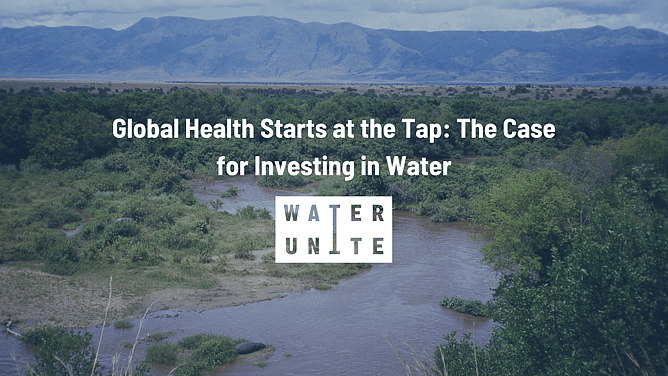
Water is a foundational pillar of infrastructure along the Congo River, providing transportation, food sources and livelihoods. Yet its vital role in local economies and lifestyles masks a more sinister potential: a corridor for disease outbreak. In 2025, the Democratic Republic of Congo experienced its worst outbreak of Cholera in 25 years, recording 64,427 suspected cases and 1,888 deaths (UNICEF, 2025). Transmission persisted into 2026 among fishing communities along Lake Tanganyika, where limited access to safe water and sanitation sustained the epidemic (Shangalume et al., 2026).
The outbreak was not caused by an absence of clinical knowledge. Cholera is preventable and treatable. Its persistence reflects an earlier failure in the health system: contaminated water, inadequate sanitation services and overstretched infrastructure, together constituting an ideal environment for disease.
Discussions of global health infrastructure evoke a familiar image: clinics, medicines and healthcare workers. These remain indispensable, but their action is largely confined to damage mitigation after outbreaks have begun. Unsafe water, sanitation and hygiene contribute to at least 1.4 million preventable deaths annually, while 2.1 billion people still lack safely managed drinking water (WHO 2025). The global health system is designed to respond when illness arrives, but water determines the magnitude of its arrival.
The Cost of Unsafe Water
Unsafe water rarely appears on a household bill, but it comes with a cost nonetheless, and it is charged twice over. The first bill arrives through illness. Diarrhoeal disease brings recurrent treatment costs, working days lost to sickness or to caring for the sick, and interrupted schooling. For households bearing little financial margin, each episode redirects income away from food, education and productivity, so that the cost of a single illness is rarely one-off.
These costs are cumulative, and they fall hardest on the youngest. Periodical infection in early childhood is associated with developmental delay and stunted growth, impacting a child’s future long before they have had the chance to shape it (WHO 2025). Repeated illness undermines the ability to absorb nutrients, and the resulting frailty makes the next infection more likely and more severe. What begins as a series of individual episodes gradually settles into a pattern of lost weeks of schooling, weaker learning outcomes and diminished earning capacity in adulthood.
Along Lake Tanganyika, that pattern is visible in aggregate. The 64,427 suspected cases recorded across the Democratic Republic of Congo represent households absorbing treatment costs, lost working days, and prolonged periods of care. Alongside this, clinics are also obliged to divert staff, beds and supplies towards an illness that safe water and sanitation would have prevented from arising. Where transmission persists across successive seasons, communities are not recovering between outbreaks. Instead, communities carry a lasting burden that never fully resolves.
The Hours Behind the Water
The second bill is imposed through time. In regions where water is remote or unreliable, hours are surrendered to fetching it; hours drawn from the same limited household budget of energy that illness has already depleted. For children, collection competes directly with the school day, and with the rest and study necessary for their growth.
This burden falls disproportionately on women and girls, who are the principal water collectors in nearly 80% of households without direct access across Sub-Saharan Africa (World Bank 2024; 2025). The hours involved displace paid work, small enterprise, farming, caregiving and education, irrespective of whether anyone in the household is currently unwell. Long or unsafe journeys carry their own risks, and the unpredictability of supply makes it difficult to plan work or study around it. The result is a quiet and continuous constraint on what a household is able to earn, learn and decide for itself.
The health and time charges are one bill, presented twice. Treatment drains a household’s income, while collection drains its capacity to earn that income back. Both originate at the same point, and both fall on the same people. This is why the case for water is so critical: safe, reliable access protects the time, health and economic opportunity on which a household’s future depends.
Two Strategies, One Agenda
Water’s indelible influence on health and economic stability is increasingly recognised within international development policy, particularly in strategies addressing persistent infrastructure gaps. The U.S. Global Water Strategy positions water and sanitation as foundations of health security, growth and resilience. It connects equitable, climate-resilient WASH access with stronger local institutions and more durable financing. Water is therefore embedded within national development planning, with implementation directed through national and local systems serving underserved populations (U.S. Department of State 2022).
The America First Global Health Strategy approaches the same challenge through health-system reform. Rapid outbreak detection and front-line delivery are paired with country co-investment and a gradual transfer of responsibility to local government, private enterprise and other domestic institutions (U.S. Department of State 2025).
Together, the strategies reveal the link between prevention and system resilience. Surveillance can identify diseases, while clinics can treat patients and vaccination can slow transmission, but their impact is undermined when contaminated water and inadequate sanitation continue to create new exposure. Persistent preventable diseases absorb clinical capacity, public funding and household productivity. This also erodes the self-reliance these strategies seek to build.
Water infrastructure is therefore a force multiplier for global health. By reducing the burden reaching clinics, it protects health-system capacity and preserves the time, income and productivity on which domestic resilience depends. Water must be centred within health-system planning, financing and delivery, not treated as a periphery.
Credit: Alexander James-Aylin
From Ambition to Impact
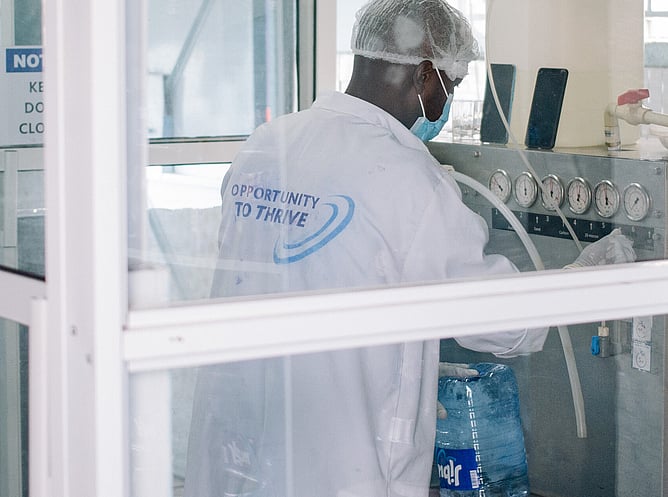
Preventive architecture takes shape through the enterprises that deliver services on the ground, in the same markets where outbreaks such as the one along Lake Tanganyika take hold. Jibu, a Water Unite programme partner, illustrates how safe supply can be built into local economies rather than delivered to them.
Jibu expands access to affordable drinking water through a decentralised franchise network spanning eight countries across East Africa. Local entrepreneurs receive the infrastructure, training and supply-chain support needed to produce and distribute water within their own communities. In 2025, the network produced nearly 180 million litres of clean water whilst reaching over 650,000 daily beneficiaries. This is made possible through189 production franchises, with further economic opportunities unlocked across more than 13,000 retail points (Water Unite 2026). The model embeds ownership, jobs and service delivery within local markets, strengthening both access and economic participation.
Because the franchises are locally owned and commercially operated, supply does not depend on the duration of an external programme. Treated water is produced close to the households that buy it, reducing both the cost of distribution and the hours spent collecting it. The retail network also extends into neighbourhoods that centralised utilities have yet to reach, enabling reliable water access to grow through locally embedded businesses rather than waiting for large-scale infrastructure expansion.
Financing the First Line of Defence
Recognising water as central health infrastructure is a critical first step, yet equally important are the models to finance scalable solutions. Enterprises tackling these issues within underserved markets frequently occupy the “missing middle”: too established to apply for small grants but considered too risky for commercial investors. They require patient capital to establish the infrastructure needed for self-reliance and greater private sector participation.
Water Unite serves to address this. Corporate partnership models channel micro-levy contributions from everyday product sales into catalytic capital which, deployed through blended-finance structures, absorbs early risk and makes institutional and private investment more viable. In 2025, this approach secured a US$7.5 million recommitment from the U.S. International Development Finance Corporation, the U.S. government's development finance institution, and US$1.4 million from Aqua for All, an international foundation established by the Dutch water sector. The portfolio now spans seven investments across thirteen countries (Water Unite 2026). The purpose of such finance is to widen the pool of capital available for water delivery, so that governments, utilities, public health systems and local enterprises can perform complementary roles in markets that conventional finance has overlooked.
The Congo outbreak offered a stark illustration of the risks tied to an overreliance on healthcare systems that intervene only after illness has taken hold. Medicines and surveillance systems are critical to epidemic control, but their impact is repeatedly undermined where contaminated water and inadequate sanitation perpetuate the conditions for disease.
For a child, water is inextricably linked to health, development and opportunities to learn. For a household, it protects families’ agency and income. For a country, it strengthens human capital and supports economic stability. There is an irrefutable need for water to be embedded within health planning, development finance and corporate partnership strategies. The first line of global health is not always the clinic, it begins in the infrastructure that prevents illness from arising at all.
References
Shangalume, F.I., Tshimbalanga, D., Degina, D., Muboyayi, M.K., Matata, O.B., Tague, C. and Akilimali, A. (2026) ‘Resurgence of cholera on the shores of Lake Tanganyika: security instability in eastern Democratic Republic of Congo as an aggravating factor and call to action’, Conflict and Health, 20(1), article 4. doi: 10.1186/s13031-025-00742-5. https://pmc.ncbi.nlm.nih.gov/articles/PMC12821265/
UNICEF (2025). Democratic Republic of the Congo cholera outbreak is declared country’s worst in 25 years. https://www.unicef.org/press-releases/democratic-republic-congo-cholera-outbreak-declared-countrys-worst-25-years
U.S. Department of State (2022). U.S. Global Water Strategy 2022-2027. https://councilonstrategicrisks.org/wp-content/uploads/2025/01/29.-US-Global-Water-Strategy-2022.pdf
U.S. Department of State (2025). America First Global Health Strategy. https://www.state.gov/wp-content/uploads/2025/09/America-First-Global-Health-Strategy-Report.pdf
Water Unite (2026). Annual Impact Report 2025. https://www.waterunite.org/site_files/7323/upload_files/Water%20Unite%20Annual%20Impact%20%20Report%20-%202025.pdf?dl=1
WHO (2025). Drinking-water: Key Facts. https://www.who.int/news-room/fact-sheets/detail/drinking-water
World Bank (2024). The Gendered Burden of Water Collection in Sub-Saharan Africa. https://www.worldbank.org/en/data/interactive/2024/03/13/gendered-burden-of-water-collection-in-afe-afw-sub-saharan-africa
World Bank (2025). New Program to Accelerate Access to Water, Sanitation, and Hygiene for 30 Million People in Eastern and Southern Africa. https://www.worldbank.org/en/news/press-release/2025/09/30/new-program-to-accelerate-access-to-water-sanitation-and-hygiene-in-eastern-and-southern-africa