
For decades, investors could point to the reason why the financing gap in water was not closing: a lack of measurable, transparent data for on-the-ground solutions. The slow response of capital markets created a cycle of declining water security and underinvestment. Despite being a material risk to most supply chains, and undervalued as a socioeconomic driver, water is still missing $6.7 trillion in infrastructure funding (WEF 2024; GWI 2025)
The financing landscape — and technology — has changed. The economy has shifted from manufacturing toward technology and information sectors. Surging investment and growth in these companies led analysts to predict that in the ‘New Economy’, water will be the main constraint (GWI & Xylem 2026). Plenty of coverage has already highlighted the environmental footprint of AI. Data centers demand constant water supply to build, train and prevent systems overheating (WRI 2026; SNHU 2025). Usage is expected to increase, making water an even greater dependency for future world growth. But AI's capability to measure, model and optimise is the very thing the water sector has been missing. In fact, the technology scaling demand is best placed to fund the solution. Here’s how.
Data De-risks Investment
Interest in water has now moved beyond solely ESG criteria. The amount of corporations looking to invest in water to fortify their own supply chains is increasing (Goldman Sachs 2026); one in five report water-related supply chain risks. The blue economy is valued in the trillions (World Economic Forum 2026). Yet few viable routes into the sector existed for investors. Concerns over pricing transparency, limited data, and fractured governance, meant water remained unviable for commercial investors (Time Investments 2026). Weak infrastructure locked the sector into a vicious cycle of underinvestment.
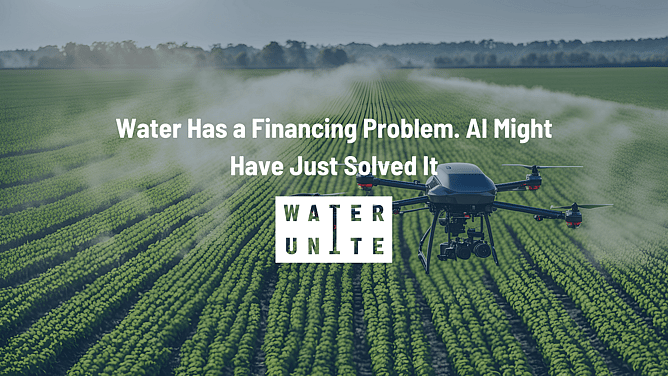
AI-driven solutions in agriculture are beginning to shift that. The agriculture sector is water-intensive, using 70% of global freshwater, compared with 5% for AI. Every year, millions of gallons of water are lost from inefficient irrigation systems across the industry. Agritechs are adopting AI technologies to advance water savings, which range between 15-30% (FT Rethink 2025; Xylem 2026). In practice, this scale of water efficiency offers greater long-term environmental returns than water reduction efforts.
The AI benefits are significant and twofold. For smallholders, the technology reduces water and energy usage while maintaining or improving yields. For investors, AI provides real-time data on water stewardship, the assurance capital needs before committing. Priced and quantified water dismantles the main historical barrier to investment, transforming resource efficiency into an asset class. By making outcomes visible, AI allows water to be financed and scaled at speed.
The Race to Finance Water Security
Earlier this year, the U.N declared a state of “Global Water Bankruptcy”, where demand and depletion exceed the rate of replenishment (U.N. 2026). Scientists on the white paper concluded that water scarcity is persistent, and worsening. While water has always been important for large global industries, this importance is set to snowball (UNFCCC 2025).
Semiconductors, AI data centers and the energy transition all need water. Mining the lithium for electric vehicles consumes around 2 million litres per metric ton (Time Investments 2026). In addition, green hydrogen production, for zero carbon emission electricity, uses 1-1.5 billion cubic metres of water per year. Every day, 20-38 million litres is used at a single semiconductor plant (GWI 2026). It’s unsurprising for water to be in-demand; these major industries are proof that water has transformed from an environmental concern into a strategic economic input.
Incentives to invest are also improving. Water-focussed bonds are citing higher liquidity compared to general green bonds, and every $1 invested in water infrastructure generates $1.30 in Gross Value Added (S&P Global 2026; GWI & Xylem 2026). Policy is consolidating these improvements. The EU and UK Water White Paper (2026) have formalised water as an asset with tradable rights and pricing tiers, in consequence, this gives capital the legal frameworks it once lacked (EU Commission 2026).
Case Study: Seabex
Agritech innovator Seabex, a Tunisian-French company and Water Unite Impact investment, uses a sensorless AI-powered platform to improve irrigation systems. Currently they manage over 50,000 hectares of land. The platform delivers real-time updates and recommendations to limit leaks and mismanagement, relying on satellite imagery for a combination of data. Field-level guidance extends across soil characteristics, weather analysis and terrain data. But at a fraction of the cost of on-farm hardware (Business Wire 2024). Using geospatial, weather, and soil data, AI systems monitor crops and direct nutritional choices. Analytic reports measure the hydration of leaves, a key indicator of crop health.
What this means for water is reliable verification of farms and smallholders and consequently reduced water consumption overall. AI-driven platforms are improving credibility, transparency and trust in water investment. They also slash freshwater usage (Water Unite Impact 2024; Seabex 2024).
More significantly, agritechs like Seabex reduce the infrastructure expense associated with traditional water monitoring. Because verification can be delivered remotely and at lower cost, scalable water management becomes more viable across regions where only conventional systems are accessible. The pipeline of small and medium agricultural businesses, capable of demonstrating measurable performance to investors and lenders, expands. Increased investment in water security becomes not just plausible, but likely.
After the Data Drought
The underinvestment and oversight towards the water management sector wasn’t by chance. It was the result of invisibility. As AI-based agritechs scale, financial infrastructure is following suit. This is helping address a critical 'missing middle', where promising innovations have outgrown pilot funding but remain beyond the reach of conventional investment approaches.
Blended finance is gaining momentum as a solution to this. Creditors can shift from input-based funding to performance-based models where investment is tied to outcomes: litres saved, leaks reduced, and clear gains in efficiency metrics. Verification encourages first-loss capital to de-risk water projects earlier, allowing commercial investment to move faster and further. AI becomes the transparency layer for banks and international lenders within blended finance structures.
Historically, water could not attract capital because performance verification was unreliable or nonexistent. Now, investors can move from ESG goals to data-backed performance targets. That reduced risk allows blended finance to enter the space with the same urgency seen in energy or transport infrastructure. For future prospects, there remains a paradox: the same AI technologies increasing pressure on global water supply are creating the transparency, and therefore the opportunity, needed to scale and protect it. The data drought is ending. What follows is a reallocation of capital toward priced, verified, and now-scalable water solutions.
References
Global Water Intelligence & Xylem (2026). Watering the New Economy: Managing the impacts of the AI revolution. https://amp.xylem.com/m/aa10f8022757c5e/original/Watering-the-New-Economy-DIGITAL-final.pdf
Goldman Sachs (2025/2026). Investment Opportunities in the Global Response to Water Stress. https://universalwaterregistry.medium.com/investment-opportunities-in-the-global-response-to-water-stress-goldman-sachs-report-b3bbac016d5a
S&P Global Ratings (2026). Sustainable Bonds Global Outlook 2026: Consolidation, Not Expansion. https://www.spglobal.com/ratings/en/regulatory/article/sustainability-insights-sustainable-bonds-global-outlook-2026-consolidation-not-expansion-s101668325
U.N. (2026). Global water bankruptcy: Living beyond our hydrological means in the post-crisis era (UNU-INWEH). https://www.preventionweb.net/publication/documents-and-publications/global-water-bankruptcy-living-beyond-our-hydrological-means
World Economic Forum (2026). Adaptation through Water: Scaling Private Sector Finance for Climate Adaptation. https://www.weforum.org/publications/adaptation-through-water-scaling-private-sector-finance-for-climate-adaptation-in-southeast-asia/
Xylem (2026). Water Technology Trends 2026: Digital Water and Operational Efficiency. https://www.xylem.com/en-uk/info/xylem-vue-water-technology-trends-2026/