
As we wrap up the first month of 2026, it is the perfect moment to pause and reflect on the tides of change that shaped the global water sector over the past year. 2025 was a year of stark contrasts: the persistent weight of global challenges met by a rising wave of human ingenuity. By looking back, we can better understand the roadmap ahead; one that moves us from a state of crisis toward resilience.
At the heart of this reflection lies a sobering reality. Water poverty remains one of the world’s most pressing challenges.
Today, 2.1 billion people still lack access to safely managed drinking water (WHO/UNICEF JMP, 2025). This is not just a statistic, but a daily struggle for health and dignity. The burden is felt most acutely by women and girls, who continue to shoulder the responsibility of collection in water-scarce communities.
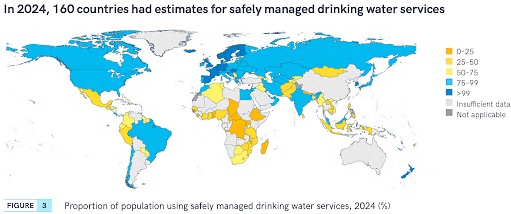
(2025) WHO/UNICEF joint monitoring programme for Water Supply, sanitation and hygiene.
In 2025 alone, women and girls spent an estimated 250 million hours every day collecting water (Omer, 2025), time that could otherwise be spent in school, at work, or building economic independence. These realities underscore how deeply water insecurity is intertwined with inequality, opportunity, and long-term development.
Yet, even amid these challenges, 2025 also delivered powerful examples of progress, particularly in how water reaches remote and underserved communities.
In Chile, decentralised autonomous water units proved more cost-effective and reliable than traditional truck delivery systems. By integrating predictive artificial intelligence, Remote Water’s technology now monitors everything from salt levels in desalination processes to solar power performance in real time. This allows technicians to resolve issues weeks before failures occur, making local, resilient water systems viable in regions such as Antofagasta and the fjords of Patagonia (IDRA, 2025).
A similar shift toward sustainable access emerged in Djibouti, where construction began on a solar-powered desalination plant in Dalaf (ESI Africa, 2025). The project has already provided 5,000 residents with a reliable source of clean water, reducing dependence on costly and volatile fossil fuel markets. These innovations show that when we prioritise reliability and resilience, we are not just delivering water, we are fostering stability, cooperation, and what many describe as 'water peace.'
Beyond freshwater access, the health of our oceans and rivers reached a critical tipping point in 2025.
An estimated 170 trillion plastic particles now float in our oceans (Eriksen et al., 2023), breaking down into microplastics that infiltrate freshwater systems, food chains, and ultimately human bodies. These pollutants degrade water quality, disrupt ecosystems, and create conditions in which pathogens can thrive. The result is a direct and devastating impact on human health: over 400,000 children under the age of five die each year from diseases linked to unsafe water and poor sanitation (Randriarimalala, 2025). That is one child lost roughly every ninety seconds.
Faced with these realities, the international community responded with unprecedented legal and environmental action.
On September 19, 2025, 60 countries ratified the High Seas Treaty, establishing a long-awaited legal framework to protect biodiversity in international waters (HSA, 2026). The treaty empowers governments to restrict industrial activity in ecologically sensitive areas, giving marine ecosystems a chance to recover.
This legal clarity has already accelerated large-scale restoration efforts. In 2025, The Ocean Cleanup removed a record 25 million kilograms of plastic waste from oceans and rivers worldwide (Viglianisi, 2025). Together, these efforts demonstrate how policy and technology, when aligned, can begin to operate at the scale the crisis demands.
Looking ahead, however, the pressure on global water systems continues to mount. By 2030, more than half of the world’s population is projected to live under severe water stress. At the same time, a quarter of all freshwater species are now at risk of extinction, while agriculture alone accounts for 70% of global freshwater use (Ashworth, 2025). These converging pressures highlight the urgent need to rethink how water is managed, shared, and restored.
In response, 2025 became a turning point for nature-based solutions. In California, the completion of the Ackerson Meadow restoration project revived 230 acres of landscape, enabling the ground to naturally store an additional 70.8 million gallons of water each year (Freitas, 2025).
On a global scale, the Freshwater Challenge (led by DRC, Colombia, Zambia, and Mexico) committed to restoring 300,000 kilometres of rivers and 350 million hectares of wetlands by 2030 (The World’s Freshwater Challenge, 2025).
Innovation is also enabling us to access water in places once considered impossible. Researchers at MIT successfully piloted window-sized devices in Death Valley capable of harvesting water directly from arid air, even at humidity levels as low as 21 percent. These systems produced between 57 and 161.5 millilitres of drinking water per day (Chu, 2025), underscoring how scientific breakthroughs can complement natural and policy-led solutions.
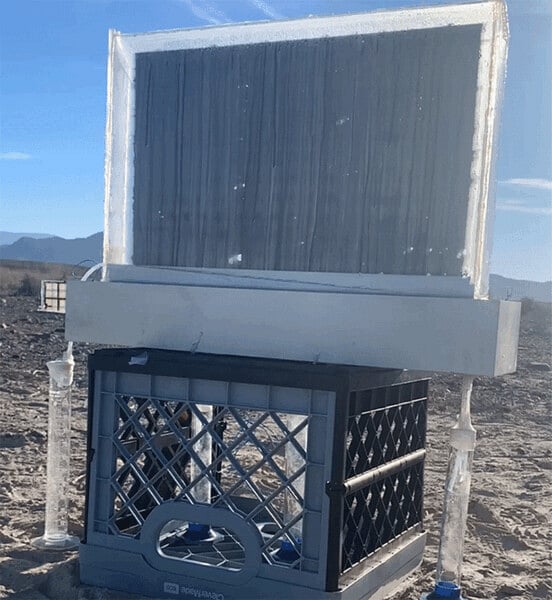
Chu, J. (2025) Window-sized device taps the air for safe drinking water.
Taken together, 2025 served as a powerful reminder: while the data can be daunting, the momentum for change is undeniable. By integrating smart technology, strong policy, and ecosystem restoration, we are beginning to reverse long-standing trends.
2025 has also been an impactful year for Water Unite. Thanks to the commitments of our micro-contribution partnerships, including with Co-op, Nestle, Suntory, Danone, Britvic and Elior, Water Unite has been able to support:
Water Security: 174,000,000 litres of safe drinking water distributed to 636,000 people [SDG 6]
Sanitation & Hygiene: 2,250 tonnes of faecal sludge safely managed [SDG 6]
Waste Management: 3,350 tonnes of materials processed [SDG 12]
Environment: 8,690 trees eq have been saved by the adoption of biomass fuels [SDG 15]
Climate: 949 of tonnes CO2 eq offset [SDG 13]
Employment & Livelihoods: 5,020 total jobs supported in emerging markets [SDG 8]
As we step into 2026, the message is clear; we must transform these individual successes into a global standard. For Water Unite, this means keeping collaboration at the heart of our work: closing funding gaps, accelerating practical solutions, and ensuring that progress protects both water resources and the people who depend on them. If you are interested in partnering with Water Unite, please visit our contact page to learn more.
References
Ackerson Meadow Restoration Project (2025) National Parks Service. Available at: https://www.nps.gov/yose/getinvolved/ackersonmeadow.htm (Accessed: 30 January 2026).
Ashworth, J. (2025) A quarter of all freshwater species are at risk of extinction, Natural History Museum. Available at: https://www.nhm.ac.uk/discover/news/2025/january/quarter-freshwater-species-at-risk-extinction.html (Accessed: 30 January 2026).
Chile’s Water Shift: From Drought to National Blueprint for Reuse and Desalination (2025) IDRA. Available at: https://idrawater.org/news/chiles-water-shift-from-drought-to-national-blueprint-for-reuse-and-desalination/ (Accessed: 30 January 2026).
Chu, J. (2025) Window-sized device taps the air for safe drinking water. Available at: https://news.mit.edu/2025/window-sized-device-taps-air-safe-drinking-water-0611 (Accessed: 30 January 2026).
Djibouti: Solar-powered desalination plant to tackle water scarcity (2025) ESI Africa. Available at: https://www.esi-africa.com/news/djibouti-solar-powered-desalination-plant-to-tackle-water-scarcity/ (Accessed: 30 January 2026).
Eriksen, M. et al. (2023) A growing plastic smog, now estimated to be over 170 trillion plastic particles afloat in the world’s oceans—Urgent solutions required, PLOS ONE. Available at: https://journals.plos.org/plosone/article?id=10.1371%2Fjournal.pone.0281596 (Accessed: 30 January 2026).
Freitas, M. (2025) Restoring ackerson meadow: A historic milestone in headwaters conservation, Restoring Ackerson Meadow A Historic Milestone in Headwaters Conservation Comments. Available at: https://www.americanrivers.org/2025/09/restoring-ackerson-meadow-a-historic-milestone-in-headwaters-conservation/ (Accessed: 30 January 2026).
Historic High Seas Treaty enters into force, launching a new era of global ocean governance (2026) High Seas Alliance. Available at: https://www.citethisforme.com/cite/sources/websitemanualcite.
Randriarimalala, E. (2025) Water at the epicenter of 2025 global risk report, says WaterAid, WaterAid. Available at: https://www.wateraid.org/uk/media/2025-global-risk-report (Accessed: 30 January 2026).
Viglianisi, M. (2025) Year in review: The Ocean Cleanup continues to break records: Updates, The Ocean Cleanup. Available at: https://theoceancleanup.com/updates/2025-in-review-the-ocean-cleanup/ (Accessed: 30 January 2026).
WHO and UNICEF (2025) ‘Progress on household drinking water, sanitation and hygiene’. WHO/UNICEF Joint Monitoring Programme for Water Supply, Sanitation and Hygiene.
The World’s Fresh Water Challenge (2025) Freshwater Challenge. Available at: https://www.freshwaterchallenge.org/ (Accessed: 30 January 2026).