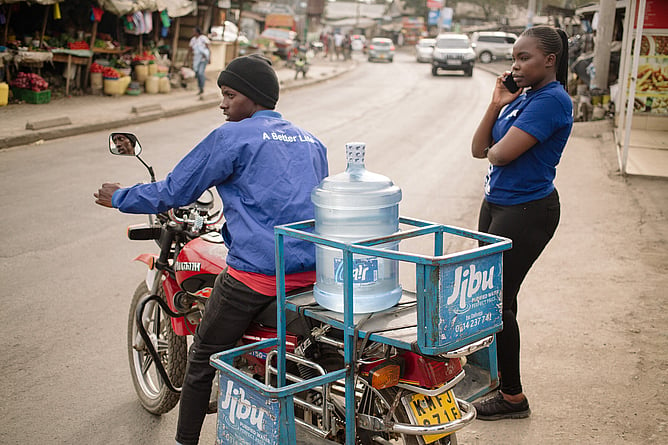
When we think of innovation, we tend to picture sophisticated technologies, groundbreaking inventions or scientific breakthroughs. Yet, while technological advancement often dominates the innovation landscape, innovation is not necessarily about creating something entirely new. Water Unite programme partner Jibu demonstrates how rethinking an established business model can be just as transformative as developing a new technology.
Innovation involves the practical implementation of ideas to create new or improved products, services or processes that deliver value. This can encompass technological advancements, but also changes to business models, organisational structures and the way existing solutions are delivered.
Speaking at World Water Week, Water Unite's Louis Goring-Morris highlighted the importance of finding sustainable business models when supporting innovation in the water sector. Referencing Water Unite investee Jibu, he explained:
“By getting the business model right and making water affordable, Jibu has now scaled to reach around half a million people a day.”
Sometimes, the key to scaling innovation isn't developing new technology, but finding a commercially sustainable way to deliver what already exists. Jibu demonstrates how rethinking an established business model can be just as transformative as developing a new technology.
The Challenge of Making Existing Solutions Accessible
Globally, 771 million people lack access to even basic drinking water services, with more than 411 million of those living in Africa. Yet many of the technologies needed to treat and purify water already exist. The challenge is often not the absence of a technical solution, but how to make that solution accessible and affordable for the communities that need it.
Traditional water supply systems require significant investment in centralised treatment facilities, pipelines and distribution infrastructure. Expanding these networks can be expensive and time-consuming, particularly in rapidly growing urban areas. Commercially bottled water offers an alternative, but the costs associated with packaging, transportation and distribution can make it unaffordable for lower-income households. In many markets, rising water tariffs have further compounded these affordability challenges, placing safe drinking water increasingly out of reach for these 411 million people.
Consequently, expanding access to clean water requires more than developing better treatment technologies. It also requires commercial models capable of delivering those technologies at an affordable price.
Innovating an Existing Model
Jibu's solution was to rethink a business model more commonly associated with fast-food restaurants and global retail brands: franchising.
Popularised by companies such as McDonald's, franchising was itself a significant business innovation. By allowing entrepreneurs to use an established brand and standardised processes, companies could replicate successful businesses across multiple locations to expand more easily.
However, traditional commercial franchising often required substantial upfront investment, limiting these opportunities to entrepreneurs with access to significant capital. Rather than using franchising to sell burgers or coffee, Jibu adapted this established model to develop a network of locally operated businesses, producing and distributing safe drinking water across sub-Saharan Africa. The company equips local entrepreneurs with water purification equipment, training, established operating systems and supply chain support, reducing the barriers to establishing and operating a water franchise.
As Jibu co-founder Randy Welsch explained:
"We flipped the franchise model on its head."
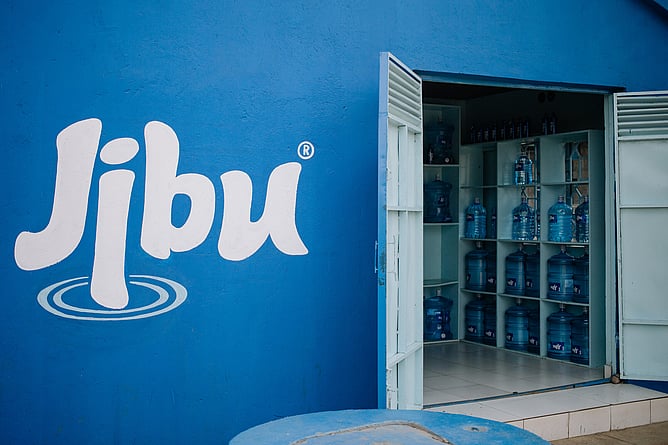
And Jibu's innovation extends beyond its financing and ownership structure. Jibu deploys compact water treatment systems within neighbourhood storefronts, transforming how purification technologies reach consumers. Instead of relying on centralised bottling facilities and extensive distribution networks, local franchises can treat and distribute safe drinking water directly within the communities they serve. To extend access to lower-income households, the Jibuntu Foundation subsidises the upfront cost of reusable bottles, enabling families who might otherwise be unable to afford the initial purchase to access safe drinking water at affordable refill prices.
The result is a decentralised model that can expand without requiring a new piped water network in each community. Importantly, Jibu's impact extends beyond improving access to safe drinking water. Its franchise structure creates opportunities for local entrepreneurs to establish and grow their own businesses, generating employment and supporting local economic development. By equipping entrepreneurs with the tools, training and support needed to operate their own franchises, Jibu helps create sustainable livelihoods and keeps economic opportunities within the communities it serves
What makes Jibu's approach particularly interesting is that neither franchising nor water purification technology is new. For many of the communities Jibu serves, commercially bottled water has traditionally been unaffordable, leaving households reliant on potentially unsafe or unhygienic sources of drinking water. Jibu offers a more accessible alternative by combining and adapting existing approaches to overcome the barriers that have traditionally prevented safe drinking water from reaching underserved communities.
Scaling Impact Through Business Model Innovation
Since its establishment, Jibu has expanded its franchise network across eight African countries, demonstrating how its decentralised business model enables the company to scale and replicate its approach across different markets. By empowering local entrepreneurs to establish and operate their own franchises, Jibu can expand its reach to produce more than 888 million litres of clean drinking water since inception, demonstrating how business model innovation can drive impact at scale.
In 2025, Jibu produced over 179 million litres of clean water during the year, reaching 650,589 consumers through a network of 189 production franchises with more than 13,000 retail points. Beyond water access, the company supported 1,646 direct jobs and 1,739 indirect jobs. Women accounted for 62 franchisees representing 29% of direct employment.
Jibu's innovation has not stopped with its original franchise model. For Jibu innovation is not necessarily a single breakthrough, but is an ongoing process of identifying and addressing the barriers that prevent a solution from providing impact.
In 2025, Jibu continued to refine its business model to overcome barriers to growth, demonstrating that innovation is an ongoing process rather than a one-off change.
In Zambia, Jibu transitioned from an Area Master Franchise model to an Operating Company structure, addressing challenges around operational stability and product supply to improve customer confidence. Following the transition, the country's franchise network expanded from one to three locations, with plans for six more.
Across its wider network, Jibu also introduced the Miller MVP Accelerator Fund to address a different barrier to growth: the upfront cost of reusable bottles for new customers. The revolving fund provides credit and subsidies to high-performing franchisees, helping them acquire new customers and generate recurring revenue. With more than $200,000 deployed, early results show participating franchisees generating incremental returns within the first months of the programme.
Together, these developments demonstrate how Jibu continues to adapt its business model to overcome practical barriers to growth, making clean water more accessible while supporting long-term commercial sustainability.
Proving the Case for Innovative Business Models
Jibu demonstrates that addressing global water challenges is not always a question of developing new technologies, but of finding commercially sustainable ways to make existing solutions accessible. By adapting an established commercial model to address the challenge of unsafe drinking water, Jibu has created a way to deliver existing technologies more affordably, whilst also generating employment and supporting local economic development.
For Water Unite, Jibu highlights that the most transformative innovations are not always technological, but about finding better ways to make a solution more accessible, affordable and capable of delivering lasting impact.